So, to say that I've been busy these past few months would be a bit of an understatement.... Its been a WILD ride so far but despite the long hours and loads of studying and tons of hard work, I have loved just about every minute of it!
So, pilot training:
We started out with Aerospace Physiology. Essentially learning all about what flying does to your body and how to take care of your body so that it can survive the rigors of flight. Also included in the Aerospace Phys was egress training where we learned what to do if we ever had an emergency that required us to get out of the aircraft immediately, either on the ground or in the air. We learned about our ejection seat, about how to handle the parachute should you have to eject, and what to do once you landed after an ejection. Not something we necessarily want to think about too much, but important to know if you ever needed it...

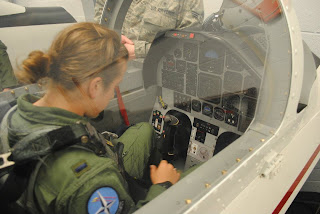
After that we started academics where we had lessons in systems (learning about the T-6 and how it works), aeronautics (basics of flight and the science and physics behind flying), contact (the initial phase of flight training where you fly based on outside references), flying fundamentals, weather, instruments (how you fly when the weather is bad and can't see outside), and navigation. This was pretty boring but I guess we needed to learn it in order to start flying!!
Your first ride in any new aircraft is called your "dollar ride." This dates back to the barnstorming days during which you could go to a county fair and pay a dollar to take a ride in the backseat of a barnstorming aircraft. This began the tradition of giving your Instructor Pilot (IP) a dollar after taking you up and down safely in one piece. My dollar ride was with our Flight Commander and apart from the fact that it was exciting to finally be flying, it was pretty non-cosmic compared to pretty much any flight afterwards. My IP did most of the flying and we didn't really do anything fun or exciting so it was basically just going up, fly around in circles for a bit, then come back down.


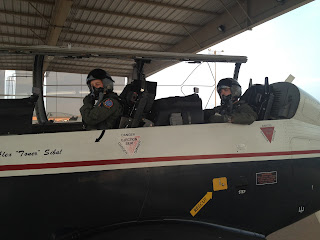
After the dollar ride, it was on to business with all our contact rides. There are only 14 rides between when you start flying and we you do your first solo and there is tons to learn in those first flights. I had some trouble getting the hang of landings but I figured it out eventually and got to go solo! This was ridiculously exciting and nerve wracking and terrifying and exhilarating all at the same time. I waked out to the plane with my IP, he watched me strap into the plane after doing the walk around inspection, gave me a high five and wished me luck, then sent me on my merry way alone! Being up in the plane by yourself is quite the experience. Its so quiet and almost peaceful when there isn't an instructor in the back seat harping on you and constantly telling you everything you're doing wrong. It was so cool just being up there, flying around, taking off and landing. I absolutely loved it and can't wait to go up solo again!


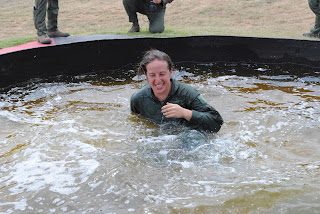
 Another tradition in the Air Force is that of the Solo Tank. Tradition is that after your initial solo your goal is to make it back to your flight room without being seen by any of your flight mates. If you do, they all owe you a case of beer. If you don't they throw you into a big tank of water (and anything else that happens to have made its way into the tank) fully clothed. The water was pretty nasty and disgusting, but it was brutally hot and the cooler water felt good and, considering the fun of the tradition, it was pretty awesome to be thrown into the tank!


After solo we got into aerobatics. I learned first and foremost that "clowns do acrobatics, pilots do aerobatics" and in addition to practicing all the maneuvers and procedures we learned thus far we added several new ones: aileron roll, split-s, loop. To be honest, I was a bit nervous about doing the aerobatics but as soon as we started doing it, it was awesome! That led into our first check ride, the midphase contact check. Check rides are essentially "exams" where they are flights in which every event is graded on a strict standard and it includes a ground eval. Its an extremely important ride that requires lots of prep and is a huge step in the pilot training progression. I had the midphase check yesterday and passed it which was a HUGE load off my shoulders and a huge relief.
Today I began my Instrument phase of flight. We started out with flying solely off the instruments but when we had done a bit of work out in the area my IP decided that a) since it was Friday and b) I had just passed my midphase check, we were going to blow off the rest of the instrument stuff for the day and just do some cloud chasing. So basically, we put the power in the jet up to max and just started flying in and around and over and through and under clouds. Loops and rolls and figure-8s and just basically screwing around in the plane. It was AWESOME! What an amazing way to spend a Friday afternoon!!
For those of you trying to get an idea of what exactly I'm doing over the course of this year, this video made by the graduating class of 12-05 does a pretty good job of explaining pilot training here at ENJJPT. Enjoy!
So, pilot training:
We started out with Aerospace Physiology. Essentially learning all about what flying does to your body and how to take care of your body so that it can survive the rigors of flight. Also included in the Aerospace Phys was egress training where we learned what to do if we ever had an emergency that required us to get out of the aircraft immediately, either on the ground or in the air. We learned about our ejection seat, about how to handle the parachute should you have to eject, and what to do once you landed after an ejection. Not something we necessarily want to think about too much, but important to know if you ever needed it...


After that we started academics where we had lessons in systems (learning about the T-6 and how it works), aeronautics (basics of flight and the science and physics behind flying), contact (the initial phase of flight training where you fly based on outside references), flying fundamentals, weather, instruments (how you fly when the weather is bad and can't see outside), and navigation. This was pretty boring but I guess we needed to learn it in order to start flying!!
Your first ride in any new aircraft is called your "dollar ride." This dates back to the barnstorming days during which you could go to a county fair and pay a dollar to take a ride in the backseat of a barnstorming aircraft. This began the tradition of giving your Instructor Pilot (IP) a dollar after taking you up and down safely in one piece. My dollar ride was with our Flight Commander and apart from the fact that it was exciting to finally be flying, it was pretty non-cosmic compared to pretty much any flight afterwards. My IP did most of the flying and we didn't really do anything fun or exciting so it was basically just going up, fly around in circles for a bit, then come back down.


After the dollar ride, it was on to business with all our contact rides. There are only 14 rides between when you start flying and we you do your first solo and there is tons to learn in those first flights. I had some trouble getting the hang of landings but I figured it out eventually and got to go solo! This was ridiculously exciting and nerve wracking and terrifying and exhilarating all at the same time. I waked out to the plane with my IP, he watched me strap into the plane after doing the walk around inspection, gave me a high five and wished me luck, then sent me on my merry way alone! Being up in the plane by yourself is quite the experience. Its so quiet and almost peaceful when there isn't an instructor in the back seat harping on you and constantly telling you everything you're doing wrong. It was so cool just being up there, flying around, taking off and landing. I absolutely loved it and can't wait to go up solo again!


After solo we got into aerobatics. I learned first and foremost that "clowns do acrobatics, pilots do aerobatics" and in addition to practicing all the maneuvers and procedures we learned thus far we added several new ones: aileron roll, split-s, loop. To be honest, I was a bit nervous about doing the aerobatics but as soon as we started doing it, it was awesome! That led into our first check ride, the midphase contact check. Check rides are essentially "exams" where they are flights in which every event is graded on a strict standard and it includes a ground eval. Its an extremely important ride that requires lots of prep and is a huge step in the pilot training progression. I had the midphase check yesterday and passed it which was a HUGE load off my shoulders and a huge relief.
Today I began my Instrument phase of flight. We started out with flying solely off the instruments but when we had done a bit of work out in the area my IP decided that a) since it was Friday and b) I had just passed my midphase check, we were going to blow off the rest of the instrument stuff for the day and just do some cloud chasing. So basically, we put the power in the jet up to max and just started flying in and around and over and through and under clouds. Loops and rolls and figure-8s and just basically screwing around in the plane. It was AWESOME! What an amazing way to spend a Friday afternoon!!
For those of you trying to get an idea of what exactly I'm doing over the course of this year, this video made by the graduating class of 12-05 does a pretty good job of explaining pilot training here at ENJJPT. Enjoy!